Showing posts with label national museum. Show all posts

Saturday, June 14, 2014

National Art Gallery

In our travel to other countries, we always see to it that we visit their museums. One can see the other countries' culture carefully preserved and commemorated. It is really fascinating to see art works of great artists, artefacts, fossils and other archeological finds.

Here in Manila , we do have our very own  National Art Gallery. It is located on a separate building at Padre Burgos Street. The National Art Gallery is one of the two divisions of the National Museum. It is in the Gallery where you will find art pieces - paintings, sculptures, relics.

 The right wing of the gallery housed Gallery I (Luis I. Ablaza Hall). It has on display colonial Philippine religious arts, carved wooden saints .

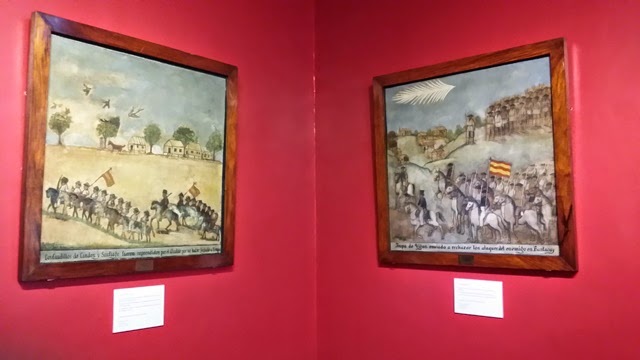
Gallery II or the FCCP Hall has on display various paintings depicting the Basi Revolt of Ilocos. The 14 paintings done by Esteban Villanueva of Vigan, Ilocos Sur were declared as national cultural treasure. The Basi revolt was the uprising of people in Ilocos  against Spanish colonial rule that would raise the tariff and restrictions of their famous sugar case wine called basi.


 Gallery IX showcased the works of Fernando Amorsolo, Botong Francisco, Vicente Manansala, Jose Joya among others.


The old Senate session hall has been preserved inside the Gallery.

 Notice the art decor on the ceiling.


Saving the best for last:

The magnificent, larger than life painting of Juan Luna - the famous award winning Spoliarium can be seen at the ground floor of the gallery. A sculpture of a muse made of reinforced concrete stands on the hallway before entering the area where only two paintings are displayed. This muse or Diwata was made by Guillermo E. Tolentino.


After passing the muse, you will behold the Spoliarium. I have goosebumps when I saw it for the first time as if I see a part of history come to life. I only saw the Spoliarium in text books back in my elementary school days. And when it was in front of me, I was almost teary eyed to see such beauty and history.


 The oil painting measuring 4.22meters x 7.675meters is considered to be the biggest painting in the Philippines. It was painted in 1884 by Juan Luna as an entry to the Madrid Art Exposition. It won for him his first gold medal. The painting is visibly chained for security reasons.


I am dwarfed by this painting.


Sharing the hall is another painting done by Felix Resureccion Hidalgo. Virgenes Cristianas Expuestas al Populacho (Christian Virgins Presented to the Populace) received one of the 14 silver medals at the Madrid Art Exposition. This painting faces the Spoliarium.

I would like to go back when the other galleries are completed.

Please do visit the National Art Gallery and have a glimpse of our  culture and art.

Open on Tuesday-Sunday 10am to 5pm.
Entrance is free on Sundays.

Their website http://www.nationalmuseum.gov.ph/nationalmuseumbeta/Museums%20and%20Branches/National1.html#g1


Rediscovering - Museum of the Filipino People

May was declared as Heritage Month. Entrance to the National Museum and Art Gallery was free for the whole month of May. On normal days, the entrance fee is Php150 for adults which will get you to the 2 museums already.

We took advantage of this and of two Saturdays in May to visit our national museum. It has been ages since I last visited the national museum.National Museum has two divisions- Museum of the Filipino People and the National Art Gallery.

It was not crowded at the Museum of the Filipino People when we visited. We parked our vehicle just after the main entrance of the museum. We logged in and started our walking tour.

The ground floor has exhibit of San Diego , the wreck site and cannons.


We took the elevator to the second floor. Surprised that the elevator was a glass capsule shaped and you can see the courtyard.

The second floor has Exhibit Gallery III The San Diego -A Homecoming Exhibit. We saw collection of jars in all sizes- big Martaban, Spanish and Siamese jars that contained the provisions for the passengers of the ship consisting of preserved fruits, sardines, salted meat, wine, vinegar and drinking water.


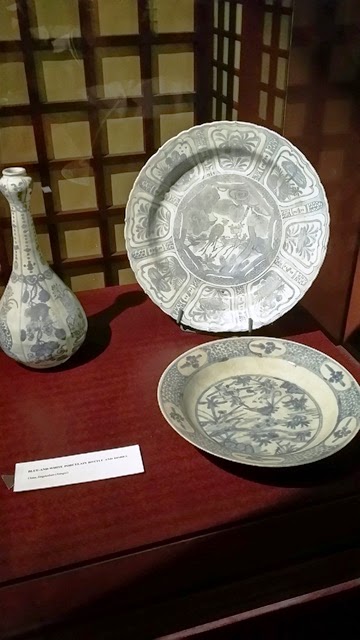
We also saw different blue-and-white porcelain with designs related to Buddhist and Taoist luck symbols, the different shapes and sizes of plates and ewers.


The Archaeological Treasures Gallery showed burial jar collections as well as samples of other earthen wares found in different caves in the Philippines.

 A reconstructed portion of  balangay or wooden boat used for trading in the early days.

 Another part of the museum is an exhibit of the origin and the development of writing in the country as well as that of contemporary Philippine dialect.


 Also in exhibit was Abel Ilokana - A celebration of Women Weavers from Ilocos.


Samples of Filipina dresses.


Please see my separate post on the National Art Gallery. Hope this inpires readers to visit our national museum.

Museum is open 10am-5pm, Tuesday to Sundays.